How to prevent and control rice blast? Carbendazim is used to control rice blast, but leaf blast and neck blast should be distinguished.
Rice blast is the most devastating of the three major rice diseases, capable of causing damage from the seedling stage to the heading stage. Based on the affected plant parts, it is classified into seedling blast, leaf blast, node blast, and panicle neck blast, among which panicle neck blast has the greatest impact on yield. The control of rice blast emphasizes preventing the spread of leaf blast and applying fungicides before boot splitting for panicle neck blast. A classic fungicide used for this purpose is carbendazim—Dafusheng 50% carbendazim wettable powder is registered for rice blast, applied at a rate of 100 g per mu (667 m²) mixed with water for foliar spraying.
The typical leaf blast lesion is described as a "fusiform spot," characterized by pointed ends, a grayish-white center, and brown margins; under high humidity, gray mold develops on the underside. Panicle neck blast manifests as brown ring-shaped lesions on the panicle neck and branches, and in severe cases, the entire panicle turns white and sterile. Leaf blast, if not carefully monitored, spreads rapidly, with spores continuing to infect the panicle; once panicle neck blast occurs, susceptible plants suffer significant yield losses. Therefore, the period from jointing–booting to boot splitting is critical for managing rice blast.
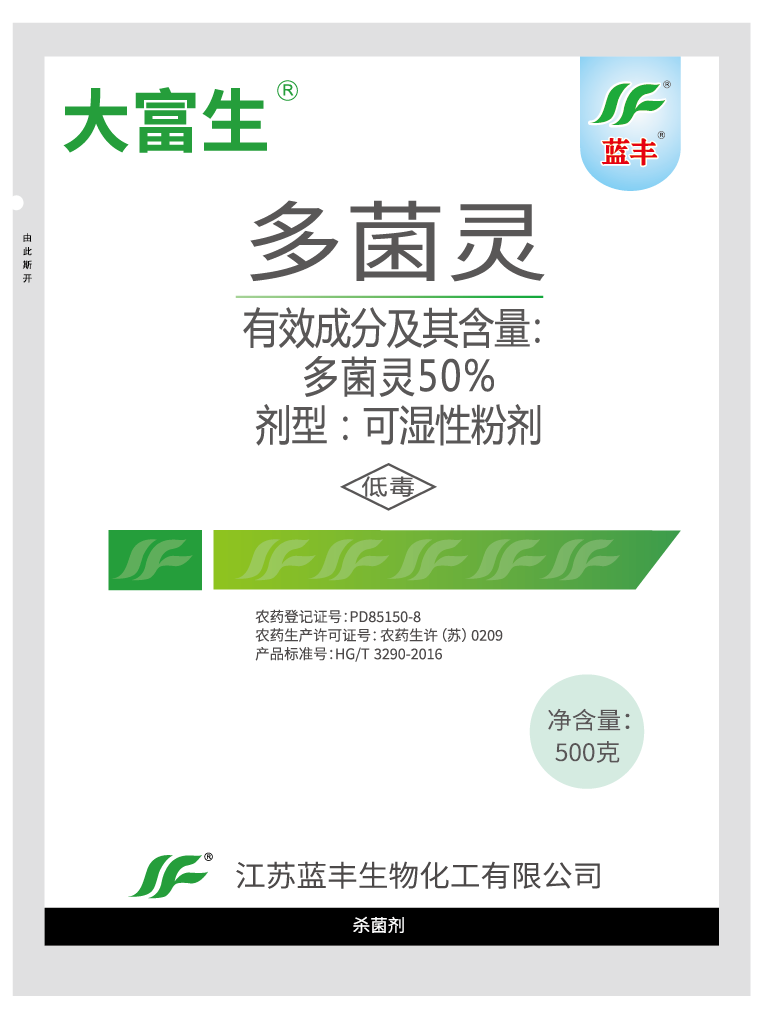
Carbendazim is a systemic fungicide of the benzimidazole class, which can be translocated upward after absorption by rice plants, exhibiting both protective and curative effects. Dafusheng 50% Carbendazim Wettable Powder is registered for the control of rice blast, with a recommended dosage of 100 g per mu (667 m²) mixed with water for uniform foliar spraying. It is generally applied twice consecutively, once before rice booting and once at the full heading stage, with an interval of 7–10 days. During the booting stage, ensure thorough spray coverage, with particular attention to the neck panicle region.
For rice blast control, timing matters more than dosage: leaf blast should be targeted at the early stage of disease onset, before lesions spread and coalesce across the field; panicle neck blast must be sprayed preemptively before boot-splitting and panicle emergence—once white panicles appear, remedial application is largely futile. Ensure sufficient water volume for spraying to thoroughly cover leaves, leaf sheaths, and panicle necks, without missing the middle-to-lower aged leaves. Avoid spraying on windy days or when heavy dew is present after rain.
Carbendazim has been used for many years, and there are signs of resistance emerging in certain rice-growing regions. It is recommended to rotate it with fungicides of different modes of action, such as tricyclazole and isoprothiolane. For specific dosage and water volume, follow the product label, as varieties and disease conditions vary by region—do not simply copy practices from elsewhere.