How to prevent and control spinach downy mildew? Apply Shuanghu at 90–120 mL/mu before disease onset.
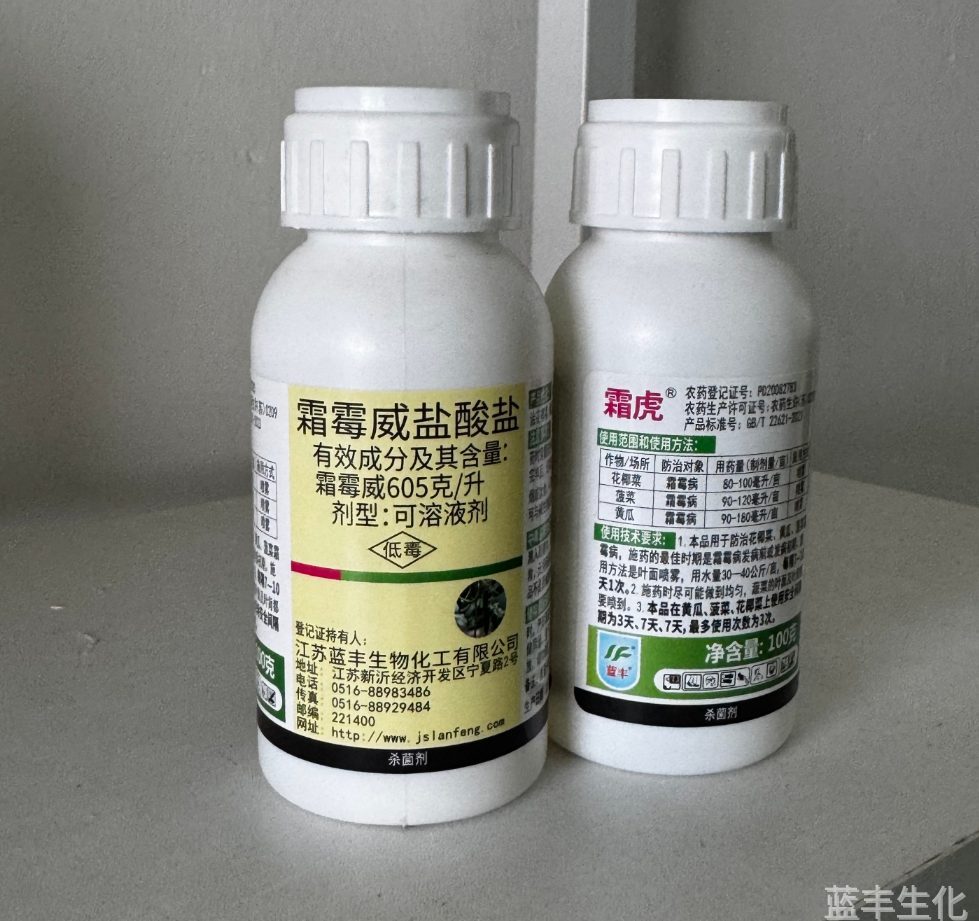
Downy mildew on spinach is an unavoidable target for control during cultivation. Failure to prevent it, or to prevent it thoroughly, is often not due to ineffective products, but rather to mistimed application or inappropriate methods. Shuanghu Propamocarb hydrochloride 605 g/L soluble concentrate (Registration No. PD20082783) is registered for the control of spinach downy mildew, at a dosage of 90–120 mL/mu, by spraying — only by aligning registration information with actual field conditions can efficacy be ensured.
Spinach downy mildew is prone to epidemic under low-temperature and high-humidity conditions, with pale yellow lesions appearing on the upper leaf surface and white downy mold developing on the underside of the leaves.
Spinach has a short growth period and high planting density, and once a disease occurs, it spreads rapidly, seriously affecting yield and quality.
Frost Tiger Propamocarb hydrochloride 605 g/L soluble concentrate (SL) is registered for the control of downy mildew on spinach at 90-120 mL/mu by foliar spray.
Registration information: Spinach — downy mildew, dosage 90–120 mL/mu, application method spray, registration number PD20082783.
Before mixing, verify three figures: dosage, water volume, and application method. The registered dosage of Shuanghu Propamocarb Hydrochloride 605 g/L Soluble Concentrate (SL) is 90–120 mL per mu, which must be strictly followed — exceeding it wastes product and poses residue risks, while underdosing fails to provide adequate control.
The two-stage dilution step must not be skipped: first dissolve the pesticide in a small amount of water to make a stock solution, then pour it into the sprayer and fill with water, mixing thoroughly. Pouring the pesticide directly into a full tank of water tends to result in uneven concentration—dilute at the top and concentrated at the bottom—so the spray will be ineffective at first and may cause phytotoxicity later.
The application method of spraying is explicitly registered and should not be arbitrarily changed to other methods. If the method is incorrect, the efficacy will be greatly reduced.
For the control of spinach downy mildew, the key is to "act before disease onset or at the early stage of infection." Propamocarb is a systemic oomycete fungicide, and its efficacy is greatest when applied at the early stage of disease development.
The spray water volume should be sufficient (registration requirement: 30–40 kg per mu) to ensure that the spray solution covers both the upper and lower leaf surfaces. Since the downy mildew sporulation occurs on the lower leaf surface, thorough coverage of the leaf underside is the key focus.
The pre-harvest interval for spinach is 7 days, with a maximum of 3 applications. This requirement must be strictly observed, especially for fast-growing leafy vegetables, as it is directly related to food safety.
With the same pesticide and the same dosage, the efficacy can vary greatly depending on who applies it — the difference lies in application quality.
First, coverage must be uniform. Maintain a constant walking speed and ensure appropriate overlap between adjacent spray swaths. Walking too fast results in insufficient coverage, while walking too slowly easily leads to overlapping application and phytotoxicity.
Second, the application must target the right plant parts. Different targets affect different parts — for foliar diseases, focus on spraying the underside of leaves; for stem-base diseases, ensure thorough coverage of the middle and lower portions; for fruit diseases, cover both the fruit surface and the peduncle. Merely sweeping the leaf surface often fails to achieve effective control.
Third, environmental conditions must be suitable. On windy days, spray drift can be severe, which not only reduces control efficacy but may also damage adjacent crops. If rain is expected within one hour, spraying should be avoided, as the spray solution will be washed off.
Fourth, maintain your equipment. Worn nozzles produce larger droplets and poorer coverage, so regular inspection and replacement are recommended. Sprayers previously used for herbicides should be thoroughly cleaned, as residues may cause phytotoxicity to sensitive crops.
The pre-harvest interval is the red line for the quality and safety of agricultural products and must be strictly observed.
The pre-harvest interval (PHI) refers to the number of days that must elapse between the last pesticide application and harvest. The specific value is subject to the product label, and varies considerably depending on the crop and the pesticide. Agricultural products harvested before the pre-harvest interval has elapsed may have pesticide residues exceeding the maximum residue limits.
The label also typically specifies a "maximum number of applications per season," which must not be exceeded either. If the number of applications is too high, cumulative residues may exceed the limit even when each interval meets the requirement.
It is recommended to establish pesticide application records: document the date, pesticide product, dosage, and applicator for each application. This is not only a requirement for quality traceability but also a basis for reviewing efficacy and optimizing treatment protocols. Large-scale growers should maintain more comprehensive records.
Long-term single use of the same pesticide will lead to resistance in target organisms—an unavoidable principle in chemical control.
The rate of resistance development is related to biological characteristics. Pests with rapid reproduction and short generation cycles (such as aphids, mites, and certain pathogens) develop resistance more quickly. Once resistance has developed, it often manifests as "the same pesticide, but it no longer works."
The correct understanding of pesticide rotation is "rotating modes of action," not "rotating brands." Different brand products with the same mode of action show no difference in resistance development. To determine this, check the active ingredient on the label—identical ingredients indicate the same mode of action.
The specific rotation scheme should be developed based on local resistance monitoring results and available pesticide resources. It is recommended to consult local plant protection departments or agricultural technical experts, and avoid arbitrary combinations based on experience alone.
Why emphasize early prevention? The math makes it clear.
In the early stage, the affected area is small and the pest population base is low, so less pesticide is required and fewer applications are needed, which naturally results in lower costs. Once the outbreak spreads over a large area, however, it becomes necessary not only to increase both the dosage and the number of applications, but also to face the risk of reduced control efficacy due to missing the optimal timing—potentially leading to irrecoverable yield losses.
Early prevention also brings a hidden benefit: reducing the pressure of later-stage control. Once the pest population base is suppressed, subsequent infestation levels naturally decrease, and both the number of pesticide applications and the costs throughout the entire growing season will decline.
Therefore, field scouting is the foundational work of plant protection. Regular field inspections are far more valuable than remedial measures after the fact. Early detection and early intervention constitute the most cost-effective plant protection strategy.
A few practical details may seem trivial but directly affect efficacy and safety in practice.
Measure accurately with a measuring device. Estimating by bottle cap or pouring by feel is the main cause of inaccurate concentration. For highly effective pesticides used in small amounts, the relative deviation of "a little extra" is particularly large, so a measuring device with accurate graduations must be used.
Add water first, then add the pesticide while stirring continuously. Reversing the order can easily cause clumping and uneven dissolution.
The pesticide mixing site should be kept away from water sources, wells, and livestock farms to prevent contamination by the pesticide. Equipment used for mixing should be cleaned after use, and the cleaning solution should not be discarded at will.
Applicators should take proper protective measures: wear long-sleeved shirts and long pants, and use masks and gloves to avoid skin and eye contact with the spray solution. Do not smoke, eat, or drink during application. Wash hands and face promptly after application.
Misconception 1: Increasing the dosage when efficacy is poor. The registered application rate of Shuanghu Propamocarb hydrochloride 605 g/L soluble concentrate (SL) is 90–120 mL/mu. Overdosing not only raises costs but may also cause phytotoxicity or excessive residues. Poor efficacy is mostly attributable to mistimed application or inadequate spray quality.
Misconception 2: Relying on experience instead of reading the label. The registered label information—including crops, dosage, application timing, and precautions—is determined through registration trials and serves as the legal basis for using the product.
Myth 3: Arbitrarily mixing with other pesticides. Mixing involves the interactions of multiple agents, which may result in antagonism or increased toxicity. It must be verified through testing and should not be done based on intuition.
Myth 4: Ignoring the pre-harvest interval. This is a red line for food safety; crops must not be harvested early just because market prices are favorable.
Safety precautions: Wear protective equipment during application to avoid skin and eye contact with the spray solution; wash promptly after application; pesticide packaging waste must not be discarded arbitrarily and should be collected and disposed of in accordance with local regulations. Before using this product, please read the product label carefully and strictly follow it, or consult a local agricultural technical expert. Climate, soil conditions, and crop growth vary across regions; actual application should be based on local agronomic guidance and the product label.